


Here’s What Sets Us Apart:
the First Time
and Affordable Pricing
Service
Lake Saint Louis, MO is a planned community, and that origin shapes a common misconception among homeowners here: that newer development means newer problems are still years away. In reality, much of Lake Saint Louis, MO was built out between the 1970s and early 2000s, putting a significant portion of the residential sewer infrastructure squarely in the range where problems begin to surface.
Planned communities also tend to have dense tree plantings along streets and green spaces, and those trees are now mature. Their root systems have had decades to work toward underground utilities. The warning signs in Lake Saint Louis, MO often arrive quietly, and they are easy to rationalize away. Here is what to watch for:
When these signs show up together, the sewer line is the first place to look.
Preston came in and did quality and outstanding work. Very personable, knowledgeable, friendly, courteous and very, professional absolutely loved him! We will be back to Beis!
We had our experience with Beis Plumbing. Kyle and Branden were fantastic! They were thorough and knowledgeable. When we need a plumber again, we are calling Beis!
Beis Plumbing did an amazing job. They responded incredibly fast and were able to schedule me right away. The technician was professional and finished the work quickly.
Steve arrived promptly, evaluated the problem and fixed the seal, thus stopping the leak!. Steve was exceptional! He was friendly, knowledgeable, efficient and gave excellent service.
Cost was reasonable and they gave me options on repair vs replace. Overall, a great experience and would definitely recommend to anyone needing plumbing work.
The geography of Lake Saint Louis, MO is defined by its lakes, the surrounding wetland buffers, and the gently rolling terrain of St. Charles County. That landscape is appealing, but it creates specific underground conditions that wear on sewer infrastructure over time.
Much of the community sits on soils with moderate to high clay content, and the proximity to Lake Saint Louis, MO itself and the smaller retention lakes throughout the development means groundwater levels in many areas stay elevated through much of the year. When soils stay saturated for extended periods, the ground supporting underground pipe beds softens, allowing pipes to shift or sag out of their original alignment. A pipe that loses its grade does not drain efficiently, and over time those low spots become chronic blockage points.
St. Charles County also experiences significant temperature swings between seasons. Hard freezes followed by spring thaws put repeated stress on pipe joints, particularly in areas where the soil moisture is already high. Cast iron and older PVC installations from the 1980s and 1990s are especially susceptible to joint failure under those freeze-thaw conditions.
The planned nature of the development also means sewer laterals in many neighborhoods run longer distances to reach municipal mains, increasing the number of joints and bends in the line and giving root systems more surface area to target over time.
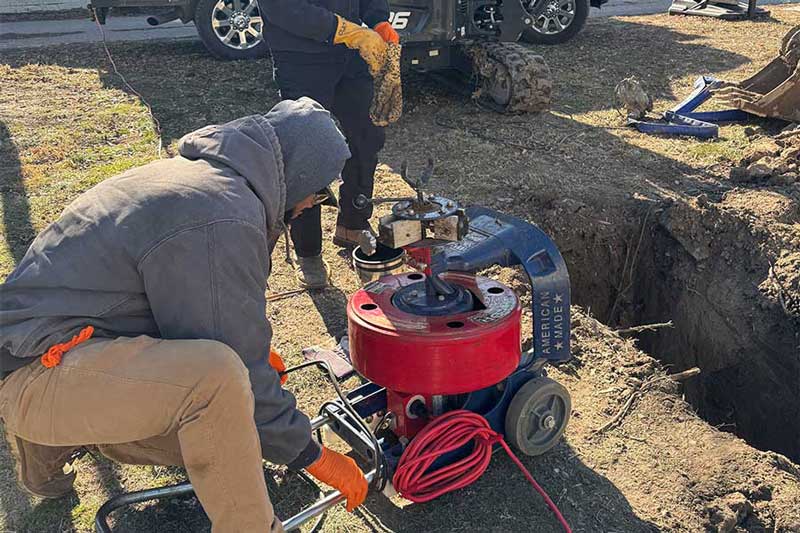
Every sewer line call at Beis Plumbing starts the same way, regardless of what the homeowner suspects. We run a camera through the line before anything else happens. That inspection tells us the location of the problem, the nature of the damage, and the condition of the surrounding pipe. It is the only basis on which we make a repair recommendation.
If the camera shows localized damage in a pipe that is otherwise in reasonable shape, cured-in-place pipe lining is frequently the right call. The liner goes in without excavation, bonds to the interior pipe wall, and produces a continuous new surface that is resistant to root intrusion and corrosion. For Lake Saint Louis, MO homeowners with finished landscaping, irrigation systems, or decorative hardscaping near the sewer line path, this approach avoids the disruption and restoration cost of digging.
When the damage is more extensive or the pipe has shifted enough that a liner would not seat properly, pipe bursting or open excavation becomes the practical path forward. We walk through the tradeoffs clearly so you understand what each option involves before you make a decision. Nothing starts until you are comfortable with the plan.
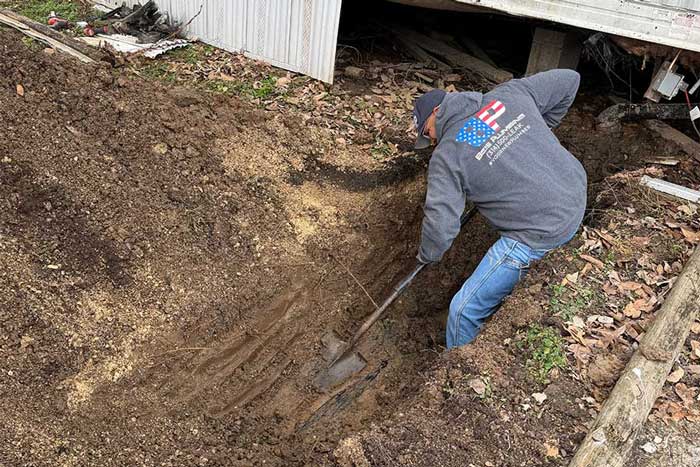
It was a fall afternoon when we got a call from a homeowner named Michelle who lived in a subdivision off Lakeview Crossing Drive. She had been noticing her kitchen sink draining slowly for a few months and had tried a couple of over-the-counter drain treatments with no real improvement. When her guest bathroom toilet started gurgling every time she ran the dishwasher, she knew it was time to call someone.
The camera told a story the drain treatments never could have fixed. Roughly 35 feet out from the house, we found a section of the original PVC lateral where tree roots from a large ornamental pear in her side yard had worked through a joint and established themselves inside the pipe. The roots had built up enough mass to restrict flow to about a third of the pipe’s diameter.
We used a pipe lining approach that cleared the blockage and sealed the compromised joint without touching her landscaping. The process took the better part of a day, and Michelle noted afterward that her drains had not run that well since she moved in. The ornamental pear is still standing.

We serve the St. Louis metro and St. Charles County, which puts Lake Saint Louis, MO squarely in our backyard. We understand the housing stock here, the soil conditions near the lakes, and the kinds of sewer issues that come with a planned community built across several decades of construction.
At Beis Plumbing, the job does not start until we know what we are dealing with, and it does not end until the repair is done right. Here is what working with us looks like:
Your satisfaction is our priority, and we back that up with how we work, not just what we say.
Beis Plumbing serves Lake Saint Louis, MO and the surrounding St. Charles County area with sewer line repair you can count on. Whether the problem is root intrusion, a shifted pipe, or something the previous owner never dealt with, we will find it and fix it the right way.
Yes. Homes built in the 1980s and 1990s are now old enough for original pipe materials to show wear, particularly at joints. Even homes built in the early 2000s may have mature trees nearby whose roots have had time to find the sewer line. Age relative to the pipe material and surrounding vegetation matters more than the home’s age alone.
PVC itself is durable, but the joints between sections are the weak points. Over time, ground movement, root pressure, and thermal expansion and contraction can cause joints to separate slightly. Once a gap opens, roots enter and grow, and the joint continues to widen. The pipe material is fine, but the connections need to be monitored in older installations.
Elevated groundwater softens the soil bed that supports the pipe. When that bed becomes unstable, the pipe can shift or develop a belly, a low spot where solids collect and blockages form. Persistent groundwater pressure can also accelerate corrosion on older iron pipes and increase hydrostatic pressure on joints.
Pipe lining seals the joint or breach that roots used to enter and creates a new interior surface that roots cannot penetrate. As long as the lining is properly installed and intact, it is an effective long-term solution. It does not, however, affect the roots outside the pipe or stop the tree from continuing to grow toward the line.
It depends on the material. Cast iron pipes have a lifespan of roughly 50 to 75 years, though environmental conditions can shorten that considerably. Clay tile pipes are similar. PVC, when properly installed, can last significantly longer, but joint integrity and installation quality play a large role in actual service life. A camera inspection is the most reliable way to assess where your specific line stands.