


Here’s What Sets Us Apart:
the First Time
and Affordable Pricing
Service
Overland is one of the older inner-ring suburbs in St. Louis County, and its sewer infrastructure reflects that history more directly than most homeowners realize. The bulk of the city’s residential development happened between the 1940s and the early 1960s, which means a large share of the sewer laterals in the ground today were installed during the Truman and Eisenhower administrations. Cast iron and vitrified clay pipe from that era was well made for its time, but it was not designed to last 70 or 80 years under Missouri soil conditions, and a growing number of those lines are now past the point where they can be managed rather than repaired.
What distinguishes Overland from some of the newer suburbs to the west is density. Lots here are compact, homes sit closer to the street, and the municipal sewer mains run through tightly developed blocks that give tree roots and ground movement less room to work than larger properties might suggest. Recognizing failure early is important precisely because options narrow when problems are left to develop. These signs are worth acting on:
If more than one of these is present at the same time, the sewer lateral is the most likely source and a camera inspection is the right next step.
Preston came in and did quality and outstanding work. Very personable, knowledgeable, friendly, courteous and very, professional absolutely loved him! We will be back to Beis!
We had our experience with Beis Plumbing. Kyle and Branden were fantastic! They were thorough and knowledgeable. When we need a plumber again, we are calling Beis!
Beis Plumbing did an amazing job. They responded incredibly fast and were able to schedule me right away. The technician was professional and finished the work quickly.
Steve arrived promptly, evaluated the problem and fixed the seal, thus stopping the leak!. Steve was exceptional! He was friendly, knowledgeable, efficient and gave excellent service.
Cost was reasonable and they gave me options on repair vs replace. Overall, a great experience and would definitely recommend to anyone needing plumbing work.
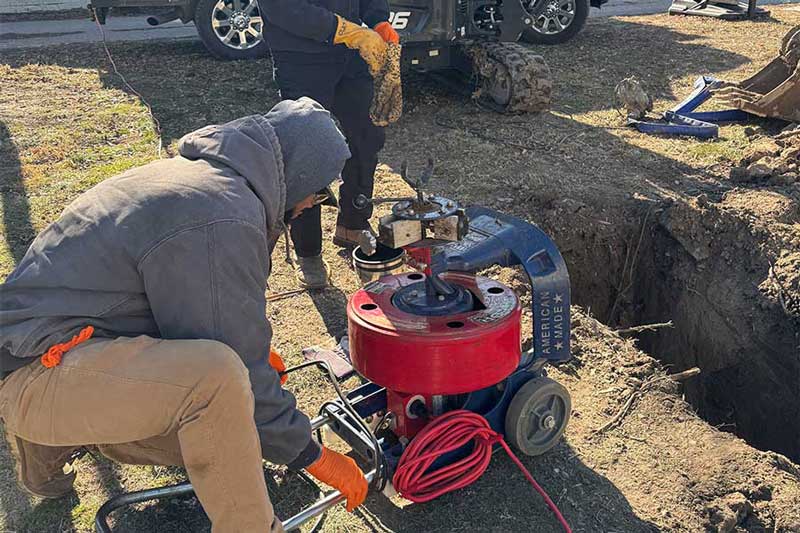
Overland’s location in the inner ring of St. Louis County puts it on geology that has been compressed, built over, and stressed by a century of dense urban and suburban development. The soils here carry a significant clay fraction, and in a built environment with as much impervious surface as Overland, the way water moves through and around those soils becomes a meaningful factor in what happens underground.
When rainfall events move quickly across rooftops, driveways, and streets without absorbing into the ground, it concentrates in areas where the soil is still permeable, including the disturbed soil around underground utilities. That cycling between saturation and drainage creates the expansion and contraction patterns in clay soil that stress pipe joints. In a neighborhood as densely developed as Overland, those cycles tend to be more pronounced than in areas with more green space and tree canopy to regulate moisture.
Overland also borders several municipalities, and the sewer infrastructure in this part of the county reflects decades of piecemeal development, annexation, and utility upgrades that did not always proceed uniformly. Some blocks have received infrastructure updates over the years while adjacent streets are still running on original mid-century pipe. That inconsistency means the age and condition of any given lateral in Overland is not something you can determine by neighborhood alone. It requires looking at the specific line.
The compact lot sizes that define most of Overland’s residential blocks also mean that trees planted close to homes, often street trees or foundation plantings from the original development era, are growing in close proximity to sewer laterals. Silver maples and elms in particular, both common in this part of the county, are aggressive root producers that seek out any moisture source they can find underground.
The density and infrastructure variability of Overland makes a camera inspection more important here than in almost any other type of community. We never assume we know what we are dealing with based on symptoms alone. The camera goes in first on every job, and what it reveals is the only basis on which we make a recommendation.
In cases where the camera shows root intrusion, a cracked joint, or a localized section of deteriorated pipe in a line that is otherwise intact, cured-in-place pipe lining gives us the ability to make a durable repair without excavating. In Overland’s tightly developed blocks, where the lateral may run close to a driveway, a neighboring property line, or a utility corridor, avoiding unnecessary excavation is not just a preference but a genuine practical advantage. The liner bonds to the interior wall and cures into a continuous sealed surface that roots cannot re-enter.
When the pipe has deteriorated beyond what a liner can address, pipe bursting lets us replace the run while keeping the footprint of the work as small as possible. We fracture the failing pipe outward and draw new pipe through the same path, which minimizes surface disruption in yards that may already have limited space. Traditional excavation remains an option when the pipe alignment or access conditions require it, and we approach it with the same transparency and care as everything else we do.
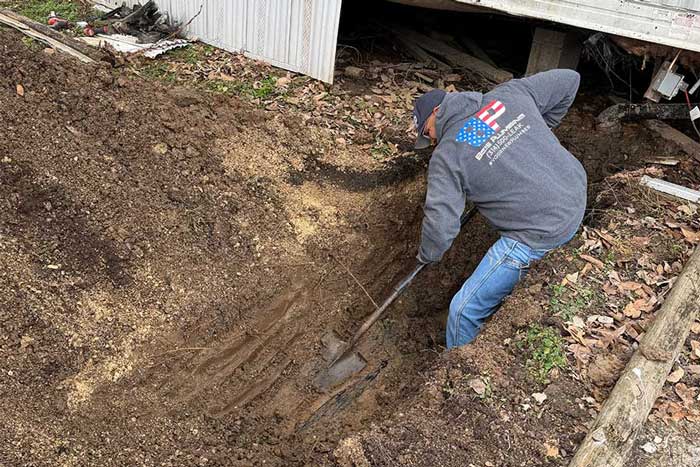

We took a call from a homeowner named Dennis who lived on Midland Boulevard in one of Overland’s postwar brick ranches. He had a finished basement that he used as a home office, and one Monday morning he came downstairs to find the floor drain had backed up overnight. There was no sewage on the floor, but the drain was clearly not clearing, and a damp smell in the space told him something was wrong further down the line.
The camera went in through the basement cleanout and traveled about 38 feet before we found the problem. A section of the original cast iron lateral had corroded from the inside out in a way that is common in pipes of this age, developing a rough interior surface that had been catching debris and gradually restricting the pipe’s diameter over time. Just beyond that section, a second issue: a joint that had separated enough to allow a root mass to establish itself, likely from a silver maple in the parkway strip between the sidewalk and the street.
Because both problems fell within a continuous stretch of compromised pipe, we lined the full section in a single pass rather than treating them separately. Dennis had a functional sewer system by that afternoon and has not had a backup since. He mentioned the floor drain had been slow for the better part of a year before the overnight backup finally made the problem undeniable.

Beis Plumbing has been serving the St. Louis area for years, and inner-ring communities like Overland represent some of the most demanding sewer line work in the region. The pipe is older, the lots are tighter, and the infrastructure history is less predictable than in newer developments. That is exactly the kind of environment where local knowledge and honest diagnosis matter most.
We do not arrive with a predetermined repair in mind. We look at what is actually there, tell you what we found, and give you a clear picture of your options before any work begins. Here is what every Overland job includes:
We built this business on integrity, and that shows up in how we work every single day.
Beis Plumbing serves Overland and the surrounding St. Louis area with sewer line repair that starts with an honest look at what is actually in the ground. If your home was built before 1965 and you have never had your lateral inspected, now is a good time. Call us and we will tell you exactly where things stand.
The sewer infrastructure in communities like Overland is simply older. Pipe materials installed in the 1940s and 1950s were not engineered to last indefinitely, and decades of Missouri soil movement, root growth, and corrosion have accumulated in ways that newer PVC installations have not yet experienced. The compressed development timeline of these neighborhoods also means a large number of laterals are reaching the end of their serviceable life at the same time.
Cast iron pipe corrodes from the interior surface outward over time. The corrosion produces a rough, scaled texture inside the pipe that catches grease, debris, and mineral buildup far more readily than a smooth surface would. As the roughness builds, the effective diameter of the pipe narrows, flow slows, and what starts as an occasional slow drain becomes a chronic partial blockage. A camera inspection shows this clearly.
Yes. Cured-in-place lining is applied to the full interior of the affected section, which means it simultaneously covers corroded surfaces and seals any joints or cracks that roots have entered or could enter. A single liner installation in a section with multiple issues is typically more practical than treating each problem separately.
It can. Very old pipe that has lost significant wall thickness or structural integrity may not provide enough support for a liner to cure properly against. This is one reason the camera inspection matters so much. It lets us assess the pipe’s current condition rather than making assumptions based on age alone, and it informs whether lining, bursting, or excavation is the right approach for the specific situation.
Most homeowners do not have this information readily available. If you have records from a home purchase inspection, those may include notes on the sewer line, though many home inspections do not include a camera scope of the lateral. The most reliable way to know the current condition of your line is to schedule a camera inspection. For a home in Overland built before 1965, that inspection is worth doing proactively rather than waiting for a problem to surface.