


Here’s What Sets Us Apart:
the First Time
and Affordable Pricing
Service
St. Ann is a compact, working community that grew up quickly in the postwar years, and most of its residential blocks were fully developed by the mid-1960s. The sewer laterals serving those homes are now between 60 and 80 years old in many cases, and the conditions they have been operating under, Missouri clay soil, seasonal freeze-thaw cycles, and the particular drainage pressures that come with a densely built landscape, have been working on those pipes for every one of those years.
What tends to catch homeowners off guard is how undramatic the early signs are. A drain that has always been a little slow. A faint smell after heavy rain. A toilet that takes slightly longer than it used to. These things get dismissed as minor quirks rather than recognized as the early stages of a sewer line problem that is still manageable. Here is what to watch for before things reach a point of urgency:
Getting ahead of these signs is almost always less expensive and less disruptive than responding to them after the fact.
Preston came in and did quality and outstanding work. Very personable, knowledgeable, friendly, courteous and very, professional absolutely loved him! We will be back to Beis!
We had our experience with Beis Plumbing. Kyle and Branden were fantastic! They were thorough and knowledgeable. When we need a plumber again, we are calling Beis!
Beis Plumbing did an amazing job. They responded incredibly fast and were able to schedule me right away. The technician was professional and finished the work quickly.
Steve arrived promptly, evaluated the problem and fixed the seal, thus stopping the leak!. Steve was exceptional! He was friendly, knowledgeable, efficient and gave excellent service.
Cost was reasonable and they gave me options on repair vs replace. Overall, a great experience and would definitely recommend to anyone needing plumbing work.

St. Ann sits directly adjacent to Lambert-St. Louis International Airport, and that proximity has shaped the community in ways that extend below ground. The airport infrastructure and the heavy commercial development along St. Charles Rock Road represent an enormous concentration of impervious surface immediately bordering a residential area. During significant rain events, water that cannot absorb into parking lots, runways, and commercial pads has to go somewhere, and it moves quickly toward lower ground, concentrating in and around the soil bordering St. Ann’s residential blocks.
That concentrated drainage creates conditions that accelerate the clay soil expansion and contraction cycles that damage pipe joints. In areas where storm drainage overwhelms the ground’s absorption capacity, the soil around underground sewer laterals experiences more frequent and more severe saturation events than it would in a community with more green space and fewer hard surfaces nearby. Each saturation and drying cycle moves the clay, and clay movement at joints is how cracks start and separations widen.
The postwar development model that shaped St. Ann also produced housing built quickly on modest lot sizes, with utility runs that sometimes reflected the construction efficiency of the era more than long-term serviceability. Sewer laterals in some blocks run at grades that were adequate when installed but have become marginal as the pipe has shifted slightly over decades of soil movement. A lateral running at marginal grade does not drain the way it should, and it accumulates the debris and buildup that precedes a blockage or backup.
The proximity to the airport also means some residential properties sit near areas that have experienced significant ground disturbance over the decades as airport facilities have been expanded, modified, or decommissioned. Ground disturbance in adjacent areas transmits through the soil and can affect pipe alignment in residential laterals that were never designed to absorb that kind of stress.
Beis Plumbing runs a camera inspection on every sewer line call before a repair recommendation is made. That is not a procedure we sometimes skip when the situation seems obvious. It is the standard, and the reason is straightforward: what a homeowner describes over the phone and what is actually in the pipe are frequently not the same thing, and the difference between them is what determines whether a lining, a bursting, or an excavation is the right call.
When the camera shows a localized problem in a pipe that retains structural integrity elsewhere along its run, cured-in-place lining is typically the most efficient resolution. The liner is introduced without excavation, positioned through an existing access point, and cured against the interior pipe wall. In St. Ann’s closely spaced residential blocks, where a lateral may run beneath a shared driveway, under a slab, or close to an adjacent utility, not having to open the ground is a meaningful advantage both in cost and in the time it takes to complete the work.
For pipe that has deteriorated more broadly or shifted enough that a liner cannot seat properly, pipe bursting or open excavation becomes the appropriate path. We explain exactly what the camera showed, why a particular method fits the situation, and what the job will involve before any work begins. Nothing about the scope changes after you agree to it.
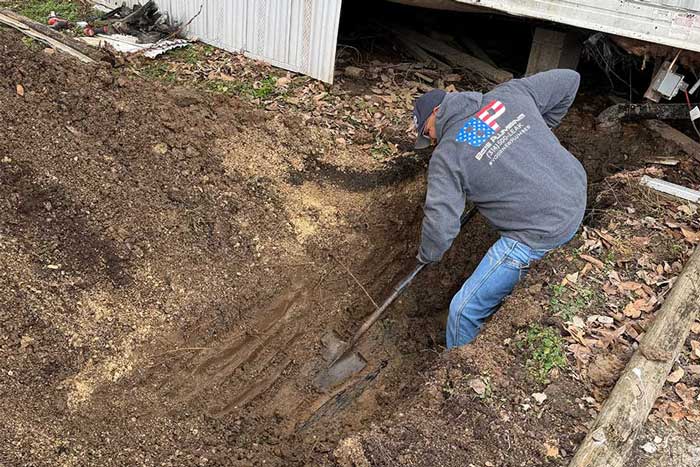
A homeowner named Linda called us on a Thursday afternoon. She had been noticing her washing machine drain backing up into the utility sink beside it every time she ran a full load, and her basement floor drain had started making a gurgling sound she had never heard before. She had lived in the house for over 20 years and said neither of these things had ever happened until a few months prior.
The camera went in and found two distinct issues within a 50-foot stretch of the original vitrified clay lateral. The first was a section about 25 feet from the house where the pipe had shifted slightly downward at a joint, creating a small but persistent belly. The second, roughly 15 feet further along, was a joint that had separated and admitted a moderate root intrusion from a parkway elm along the street.
The belly required spot excavation to re-establish proper grade on that section. The root intrusion was addressed with a liner that sealed the compromised joint and cleared the established root mass. We completed both repairs in a single visit. Linda mentioned afterward that the washing machine had been draining slowly for at least a year before the backing-up started, and that she wished she had called sooner. The two issues were independent in origin but had been compounding each other’s effects for longer than she realized.
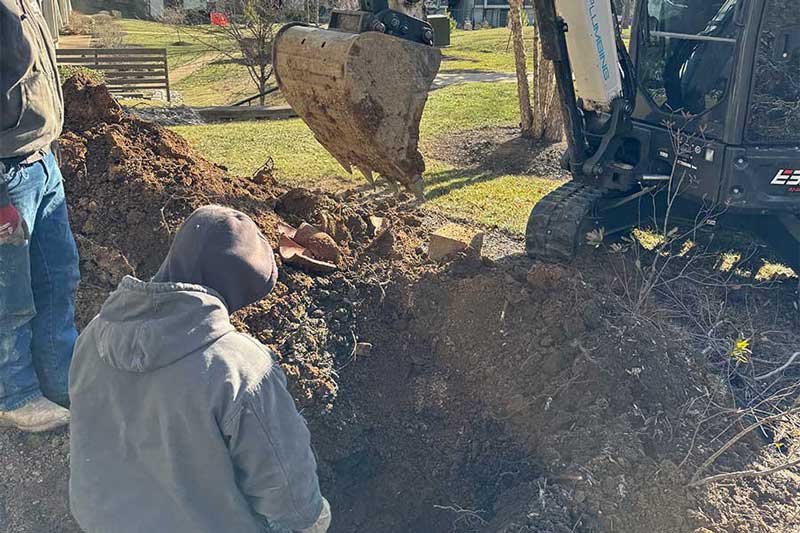
We serve St. Ann as part of the broader St. Louis area we have been working in for years. This is a community where the sewer infrastructure is old, the lots are tight, and the drainage environment adds pressure that many communities do not face. We understand those conditions, and we bring local knowledge to every job we take here.
At Beis Plumbing, working with integrity is not a slogan. It means we tell you what we actually found, recommend only what the situation requires, and do not use a camera inspection as a pretext to recommend work you do not need. Here is what every job in St. Ann includes:
We treat every home we work in the way we would want our own treated. That is the commitment we bring to every call.
Beis Plumbing serves St. Ann and the surrounding St. Louis area with sewer line repair rooted in honest work and genuine local knowledge. If your drains are giving you trouble or your yard is telling you something is off underground, do not wait. Call us and we will find out exactly what is going on.
Large concentrations of impervious surface near a residential area, such as airport infrastructure and commercial paving, redirect stormwater toward adjacent neighborhoods rather than allowing it to absorb gradually across a wider landscape. That accelerates soil saturation cycles in the clay-heavy ground surrounding residential laterals, which increases the frequency and severity of the expansion and contraction events that stress pipe joints and cause separations over time.
It depends on where each problem is located and what methods each one requires. When a belly requires spot excavation and a root intrusion can be addressed with lining, the two repairs can often be completed in the same visit if the locations are accessible and the scope is manageable in a single day. We assess this during the camera inspection and let you know upfront what the job will involve.
A laundry drain backing up typically means the lateral downstream of that connection is not moving water fast enough to handle the volume. This can result from a belly restricting flow, a partial blockage from root intrusion or debris accumulation, or a joint separation that has allowed enough infiltration to reduce the pipe’s effective capacity. It is a symptom worth investigating with a camera rather than clearing and hoping it does not return.
A sewer lateral depends on gravity and proper slope to keep solids moving toward the municipal main. When a pipe’s grade becomes marginal, whether from original installation or from soil movement over time, solids begin to settle out rather than flowing through. Over time, that accumulation builds into a partial blockage, and what was a slightly inefficient drain becomes a recurring problem that worsens with each passing year.
Homes near the airport corridor in St. Ann are worth keeping an eye on, particularly if the property is more than 50 years old and the lateral has never been inspected. Ground disturbance from decades of airport expansion and adjacent commercial development can affect pipe alignment in neighboring residential areas in ways that are not visible from the surface. A proactive camera inspection is the most reliable way to know what condition your specific lateral is in.