


Here’s What Sets Us Apart:
the First Time
and Affordable Pricing
Service
Brentwood, MO occupies a stretch of St. Louis County that has been in a near-constant state of change for the better part of two decades. The retail and commercial redevelopment along Brentwood, MO Boulevard and Manchester Road has reshaped large portions of the city’s landscape, and that surface-level transformation has a subsurface dimension that most residents never consider. The residential streets that run alongside and behind those corridors have been absorbing ground vibration, utility disruption, and drainage pattern changes from adjacent construction activity for years, and the older sewer infrastructure beneath those streets has been dealing with conditions it was never designed to handle.
The residential core of Brentwood, MO developed primarily between the 1940s and the 1960s, and the sewer laterals installed during that period are now between 60 and 80 years old. In a community where the surrounding environment has been as actively disturbed as Brentwood, MO commercial zones have been, those aging laterals are under more accumulated stress than equivalent pipe in quieter communities of the same vintage. The signs of a failing line can be easy to write off in a home that otherwise runs well. These are the ones worth taking seriously:
More than one of these occurring together is a clear signal that the lateral deserves a professional look before the situation forces the issue.
Preston came in and did quality and outstanding work. Very personable, knowledgeable, friendly, courteous and very, professional absolutely loved him! We will be back to Beis!
We had our experience with Beis Plumbing. Kyle and Branden were fantastic! They were thorough and knowledgeable. When we need a plumber again, we are calling Beis!
Beis Plumbing did an amazing job. They responded incredibly fast and were able to schedule me right away. The technician was professional and finished the work quickly.
Steve arrived promptly, evaluated the problem and fixed the seal, thus stopping the leak!. Steve was exceptional! He was friendly, knowledgeable, efficient and gave excellent service.
Cost was reasonable and they gave me options on repair vs replace. Overall, a great experience and would definitely recommend to anyone needing plumbing work.
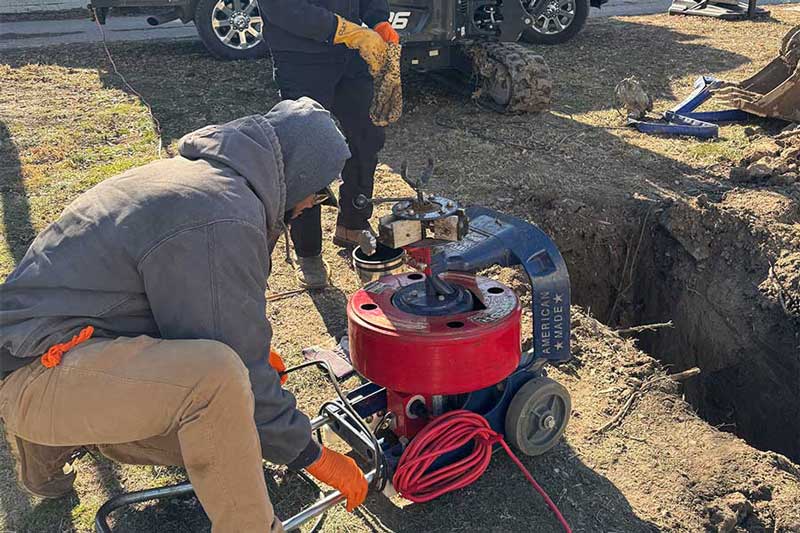
Brentwood, MO sewer infrastructure challenge is shaped by three converging pressures that do not exist in the same combination anywhere else in the immediate area.
The first is Deer Creek. The creek runs along the southern edge of Brentwood, MO, and the properties in the lower-lying residential areas of the city that drain toward it sit on soils that experience prolonged saturation following significant rain events. When clay-heavy soil stays wet for extended periods, it loses the bearing capacity that keeps underground pipes properly supported. Pipes that lose their support develop bellies, joints separate under the weight of shifting sections, and what was a properly graded lateral becomes a series of low points where solids accumulate and blockages develop. Brentwood, MO proximity to Deer Creek is not a scenic inconvenience. For the pipes beneath certain neighborhoods, it is a sustained structural threat.
The second pressure is the redevelopment activity along Brentwood, MO Boulevard and the broader commercial corridor. Large-scale construction projects generate ground vibration that transmits through the soil well beyond the project boundary. Deep foundation work, heavy equipment operation, and the installation of new utility infrastructure all introduce mechanical stress into the surrounding ground. In older clay and cast iron pipe that has already been cycling through freeze-thaw stress for six or seven decades, that additional vibration load accelerates joint fatigue and crack formation in ways that are not visible from the surface and do not produce dramatic symptoms until the damage is already substantial.
The third is the nature of Brentwood, MO residential development itself. The homes here were built quickly during the postwar suburban expansion, and the utility runs reflect the construction efficiency of that era. Some laterals were installed at grades that were marginally adequate when new and have become genuinely problematic as the pipe has shifted slightly over decades. Others run beneath driveways, garage slabs, or backyard additions that were put in after the original construction, creating access complications that make repairs more involved than they would be on a property with unobstructed yard access.
Beis Plumbing begins every sewer line job the same way. The camera goes in before any recommendation is made. In Brentwood, MO, where the range of potential failure modes is as wide as it is, a symptom-based diagnosis is not something we are willing to offer. What the camera shows is the only reliable basis for deciding what needs to be done.
When the inspection finds a localized problem in a pipe that is otherwise holding up, cured-in-place lining is usually the most practical path forward. The liner is introduced through an existing access point, positioned inside the damaged section, and cured against the pipe wall. The result is a seamless new interior surface that seals breaches, resists root intrusion, and does not require disturbing the yard or any surface above the pipe. In Brentwood, MO, where a lateral might run beneath a driveway added after the original build or under a slab that would be costly to break up, the value of a trenchless solution is substantial.
For pipe that has deteriorated beyond what a liner can rehabilitate, pipe bursting replaces the line while keeping surface disruption to a minimum. When the pipe alignment, depth, or extent of failure makes either trenchless method impractical, open excavation is the straightforward answer. We explain the situation clearly, walk through the full scope of what the job will involve, and confirm you understand and agree to everything before any work begins. The price and the scope that are agreed on at the start are what the job is when it is finished.
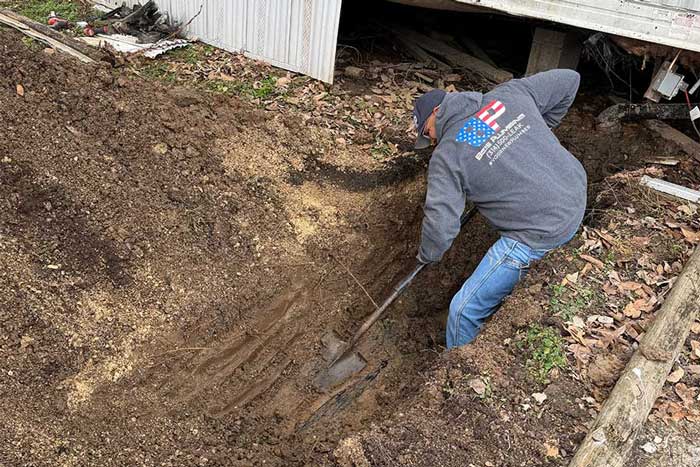

A homeowner named Diane called us on a Tuesday in late spring. Her basement had a floor drain that backed up every time there was significant rain, and she had started to notice a soft spot in her backyard about 20 feet from the house that had not been there the previous summer. She had assumed the two things were unrelated and was calling about the drain.
The camera connected them immediately. About 22 feet from the house, a joint in the original vitrified clay lateral had separated enough that surrounding soil had begun to infiltrate the pipe during rain events, partially collapsing the pipe wall on one side. The infiltration was what caused the backups during rain: stormwater saturating the soil around the compromised joint was entering the pipe and overwhelming its capacity at the same time the household was generating wastewater. The soft spot in the yard directly above the failure confirmed what the camera showed.
Further along the run, at about 45 feet, a section of the pipe had developed a pronounced belly from soil settlement, almost certainly influenced by the Deer Creek groundwater patterns that affect the lower portions of this part of Brentwood, MO during wet seasons.
We addressed the infiltration failure with a spot excavation and joint repair, then lined the belly section to restore flow and seal the compromised area. Diane mentioned afterward that the floor drain had backed up in every significant rainstorm for the past three years and she had simply accepted it as a feature of the house. It was not.
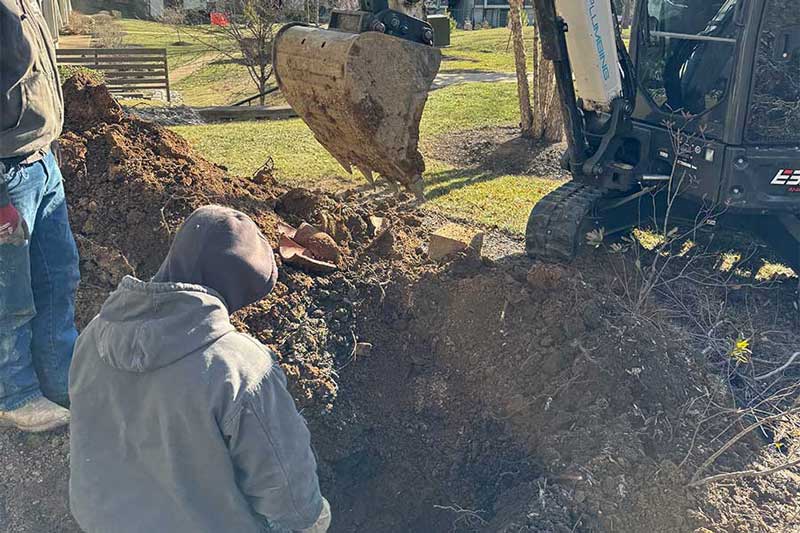
Beis Plumbing serves Brentwood, MO as part of the St. Louis area we have been working in for years. This is a community where the combination of pipe age, active commercial redevelopment, and Deer Creek drainage creates an underground environment that rewards accurate diagnosis more than almost anywhere else in the county. A plumber who shows up with a predetermined answer before looking at the pipe is not the right fit for Brentwood, MO.
We do not start with conclusions. We start with the camera, tell you what we found, and work through the options with you before a single repair decision is made. Here is what every job in Brentwood, MO includes:
We do right by the homes we work in and the people who own them. That is the standard on every call.
Beis Plumbing serves Brentwood, MO and the surrounding St. Louis area with sewer line repair built on accurate diagnosis and honest work. If your home sits near Deer Creek or within a few blocks of the commercial corridors, a proactive camera inspection is worth scheduling before the pipe makes the decision for you. Call us and we will tell you exactly what is in the ground.
Soil infiltration occurs when a pipe joint or crack opens enough that the surrounding soil begins to enter the pipe, sometimes collapsing the pipe wall inward. During rain events, groundwater saturates the soil around the breach and enters the pipe simultaneously with normal household wastewater. The combined volume can exceed the pipe’s remaining capacity, causing backups at the lowest fixtures in the house. It is a failure mode that is particularly common during wet weather and can be mistaken for a stormwater drainage issue rather than a sewer line problem.
Large-scale construction generates sustained ground vibration through heavy equipment operation, deep foundation work, and utility installation. That vibration propagates through the soil and reaches underground pipe systems in nearby residential areas. In older clay and cast iron pipe that has already experienced decades of thermal cycling and moisture stress, the additional mechanical fatigue from construction vibration can accelerate existing joint separations and introduce new cracks in sections that had not yet failed. Properties within several blocks of an active construction zone are worth monitoring more closely than those in quieter settings.
Rain-specific backups almost always indicate that stormwater is entering the sewer system somewhere between the house and the municipal main. This typically happens at a compromised joint or crack in the lateral that allows groundwater to infiltrate during saturated soil conditions. The additional volume entering the pipe during a rain event pushes the system past its capacity and causes the backup. Clearing the drain does not address the infiltration point, which is why the backup returns with every significant storm.
A soft spot developing in your yard over or near the path of the sewer lateral is a meaningful sign that something is happening underground. It can indicate soil erosion into a broken or separated pipe joint, a belly that has collapsed further, or ground settlement from sustained pipe leakage softening the surrounding soil. It is not something to wait on. A camera inspection will tell you exactly what is causing the surface change and how severe the underlying condition is.
In many cases, yes. Cured-in-place lining and pipe bursting both work through existing access points rather than requiring excavation along the full pipe run. As long as suitable access points exist at either end of the problem section, the repair can often be completed without touching the concrete above. When the damage or pipe condition makes trenchless methods impractical, the excavation scope is limited to what is strictly necessary, and we explain exactly what surface work will be involved before any decisions are made.