


Here’s What Sets Us Apart:
the First Time
and Affordable Pricing
Service
Sewer line repair is one of those jobs you want done once and done well. The line under your yard handles every gallon of wastewater your household produces, and when it breaks down, you need a fix that holds up for decades rather than a quick patch that buys a few months. Beis Plumbing provides sewer line inspection, repair, and replacement for homeowners throughout Chesterfield with that long-term goal in mind.
Every job starts with a camera inspection, so we can show you the exact location and cause of the problem. From there, we recommend the repair that fits the condition of your line and the layout of your property. You get clear communication and a team that respects your home and yard while we work.
Most Chesterfield homes were built in the 1970s and 1980s, so many original sewer lines are now 35 to 55 years old. That is old enough for joints to loosen, soil to settle, and small problems to start adding up.
Beis Plumbing is excellent at a fair price. Technician Sean was professional, courteous, and efficient. He ran a line and camera through our sewer line and kept me informed all the way. I will definitely use Sean and Beis again.
First time calling Beis Plumbing and I couldn’t be happier. My sewer line backed up while I was doing laundry and water came up around the drain in my basement. Beis was able to come out right away and fix the problem. Everyone I spoke with at Beis were so helpful, communicated well and extremely pleasant. I’ll use them again and recommend them to everyone.
They did a nice job of working through the problem and spoke with the sewer district to help bring them in to solve a problem with the main line. The only issue is that they don’t have great communication during their emergency off hours – not a firm yes we are coming or no we aren’t showing up.
Sewer trouble often shows up during the busiest moments of your day, when the most water is moving through the house.
When problems line up with heavy water use, it usually points to a restriction in the main line rather than an individual fixture. A camera inspection can confirm what is going on so you are not guessing at the fix.
A lot of Chesterfield homeowners assume a house from the 1970s or 1980s is too new to have sewer problems. In reality, conditions here can wear on a line well before it reaches the age of homes closer to the city. The pipe materials from that era, a mix of clay, cast iron, and early plastic, each have their own weak spots, especially at the joints.
The bigger issue is often the ground. Many subdivisions were built into rolling, wooded hillsides, and developers graded those slopes and filled low areas to create level lots. Fill soil and the clay beneath it continue to settle for years, and when they do, the sewer line settles with them. Humid summers, heavy spring storms, and dry spells keep the clay swelling and shrinking, which adds even more movement.
Then there are the trees. Chesterfield’s wooded lots are a big part of the appeal, but large oaks and maples near the line send roots toward any joint that leaks moisture. Freeze and thaw cycles each winter put a little more stress on pipe that is already being pushed around by the soil.


Chesterfield properties tend to come with mature landscaping, long driveways, and finished basements, so we plan every sewer repair with your property in mind. A camera inspection and line locate come first. Knowing the exact spot and depth of the damage lets us keep any digging as small and targeted as possible.
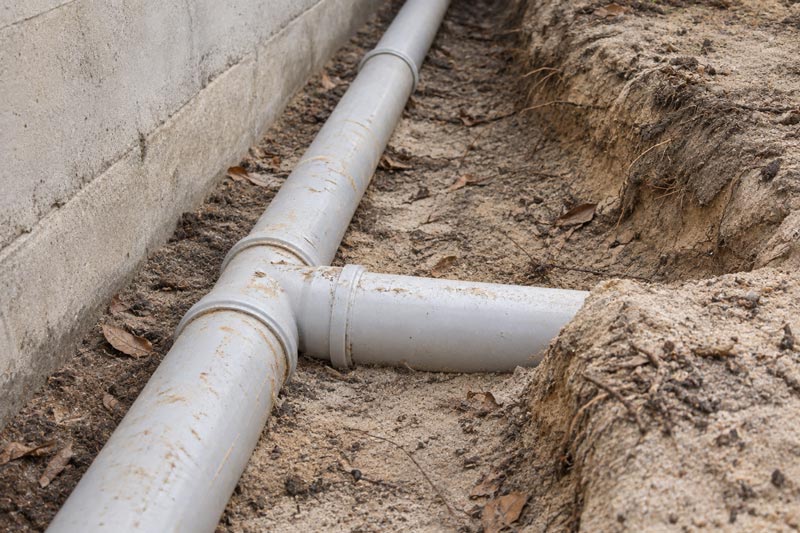
When one section is broken or sagging, we excavate just that area, replace the damaged pipe with PVC set on properly compacted bedding, and restore the surface. For lines with cracks or leaking joints that are still structurally sound, trenchless lining lets us rehabilitate the pipe from the inside without opening up your lawn or hardscape. If the line has too many problems to fix in sections, we replace it fully and lay the new pipe at a consistent slope so it drains the way it should.
We finish with a camera check to confirm the repair, then clean up the work area so your yard is left in good shape. Throughout the job, we keep you updated on what we are doing and why.
One of the most frequent problems we find under Chesterfield yards is a belly, which is a low spot where a section of sewer pipe has sunk below the rest of the line. Instead of flowing steadily downhill, wastewater pools in that dip. Solids and paper settle out, grease builds up, and over time the line clogs at the same spot again and again.
Bellies show up so often here because of how many neighborhoods were built. Established subdivisions such as Shenandoah, Westhampton Woods, and Twin Lakes were carved into rolling terrain, and the soil around many sewer lines was either fill or disturbed during construction. As that soil compacted over the years and cycled through wet springs and dry summers, sections of pipe gradually dropped. Even a slight sag can be enough to cause recurring slowdowns.
Here is how it often plays out. A homeowner like Lisa in Westhampton Woods has her main line cleared, and everything works fine for a while before the same backup returns. A camera inspection on a line like hers would show standing water sitting in one stretch of pipe, a clear sign of a belly. Cleaning alone will never fix it because the shape of the pipe is the problem.
To correct a belly, we excavate the low section, rebuild a firm and compacted base beneath it, and reset or replace the pipe at the correct slope. If several bellies are spread along the line, a full replacement with properly graded pipe is often the better choice. Either way, the goal is a line that drains on its own without repeat service calls.


When you invite a plumber into your home for something as involved as sewer work, you should know exactly what you are getting.
We built our reputation on doing the job right the first time and treating customers the way we would want to be treated. Call Beis Plumbing when your Chesterfield sewer line needs attention.
A belly is a sunken section of pipe where water and waste collect instead of flowing out, which often causes repeat clogs in the same spot.
Yes, shifting soil, tree roots, and loosening joints can all damage a line from that era, especially on hillside lots.
We pinpoint the problem first so digging stays limited to the smallest area possible, and trenchless options can avoid digging in many cases.
Recurring clogs usually point to a structural issue like a belly, root intrusion, or offset joint that cleaning alone cannot correct.
Sewer line repairs generally require a permit, and we take care of the permitting process as part of the job.
We use cookies to improve your experience on our site. By using our site, you consent to cookies.
Manage your cookie preferences below:
Essential cookies enable basic functions and are necessary for the proper function of the website.
You can find more information in our Cookie Policy and .