


Here’s What Sets Us Apart:
the First Time
and Affordable Pricing
Service
Olivette has a reputation for quiet, well-maintained streets and a housing stock that reflects the care its residents put into their properties. What is less visible is what is happening underneath those yards. The majority of Olivette’s residential development took place between the late 1940s and the mid-1970s, and the sewer laterals installed during that period are now between 50 and 75 years old. In many cases they have never been inspected, let alone repaired or replaced.
That is not unusual for this part of St. Louis County. Sewer laterals tend to get attention only when something forces the issue, and in a community like Olivette, where homes are well maintained and drainage problems might be mistaken for something minor, the issue can develop quietly for years before a homeowner realizes what is actually happening. These are the signs worth paying close attention to:
When several of these are present together, a camera inspection is the logical and necessary next step.
Preston came in and did quality and outstanding work. Very personable, knowledgeable, friendly, courteous and very, professional absolutely loved him! We will be back to Beis!
We had our experience with Beis Plumbing. Kyle and Branden were fantastic! They were thorough and knowledgeable. When we need a plumber again, we are calling Beis!
Beis Plumbing did an amazing job. They responded incredibly fast and were able to schedule me right away. The technician was professional and finished the work quickly.
Steve arrived promptly, evaluated the problem and fixed the seal, thus stopping the leak!. Steve was exceptional! He was friendly, knowledgeable, efficient and gave excellent service.
Cost was reasonable and they gave me options on repair vs replace. Overall, a great experience and would definitely recommend to anyone needing plumbing work.
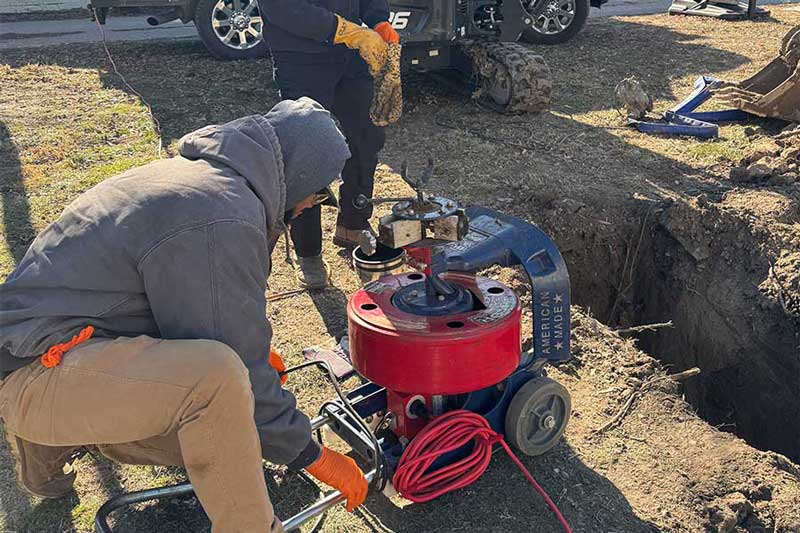
Olivette sits in a topographically varied stretch of northwest St. Louis County, with terrain that rolls between the Olive Boulevard corridor and the residential neighborhoods extending toward Creve Coeur and University City. That variation in elevation matters more than it might seem when it comes to what happens to sewer laterals over time.
Properties at lower elevations in Olivette, particularly those in neighborhoods that drain toward Deer Creek and its tributaries, sit on ground that stays wetter for longer periods following rain events than higher-ground properties in the same city. Sustained soil saturation weakens the bearing capacity of the clay-heavy soils that underlie much of this area, and when pipe beds lose their support, pipes shift. A lateral that was installed at the correct grade gradually develops low spots as the ground beneath it moves, and those low spots become the chronic blockage points that slow drains and recurring backups trace back to.
The Olive Boulevard corridor runs through the heart of Olivette, and the commercial and institutional development along that stretch has produced decades of utility work, road projects, and subsurface activity that has not always been uniform in its effects on adjacent residential infrastructure. Homes within a block or two of Olive can have laterals that have been affected by ground disturbance from road reconstruction, utility trenching, or the installation of commercial infrastructure over the years, creating alignment issues in older pipe that would not have developed in a more stable subsurface environment.
Olivette also has a substantial tree canopy, much of it composed of species planted during the original development era and now fully mature. Pin oaks, silver maples, and sweet gums are common throughout the residential neighborhoods, and all three are known for aggressive root systems that exploit any available moisture source. A lateral with a slightly separated joint anywhere along its run is effectively an invitation for a root system that has been growing toward it for 30 or 40 years.
Every call to Beis Plumbing for a sewer line problem in Olivette starts the same way. The camera goes in before anything else. What a homeowner describes as symptoms and what is actually causing those symptoms are not always the same thing, and the distinction determines whether lining, bursting, excavation, or some combination of methods is the right answer.
When the inspection reveals a localized problem in a line that is otherwise structurally sound, cured-in-place lining is typically the most efficient resolution available. The liner is introduced through a cleanout or access point and cured against the interior pipe wall, creating a new seamless surface without requiring excavation. In Olivette, where many properties have mature landscaping, established garden beds, and hardscaping that took years to develop, preserving the yard is not a minor consideration. Trenchless repair does that in a way that open excavation simply cannot.
For pipe that has deteriorated along a longer section, or that has shifted enough to prevent a liner from seating properly, pipe bursting is the appropriate step up in approach. It replaces the failing pipe by fracturing it outward while drawing new pipe through the corridor, with minimal surface disruption relative to the scope of what is being replaced. When the pipe alignment, depth, or extent of failure makes trenchless methods impractical, we handle open excavation with the same care and transparency that applies to every job. The full picture is on the table before work begins, and it does not change once you agree to move forward.
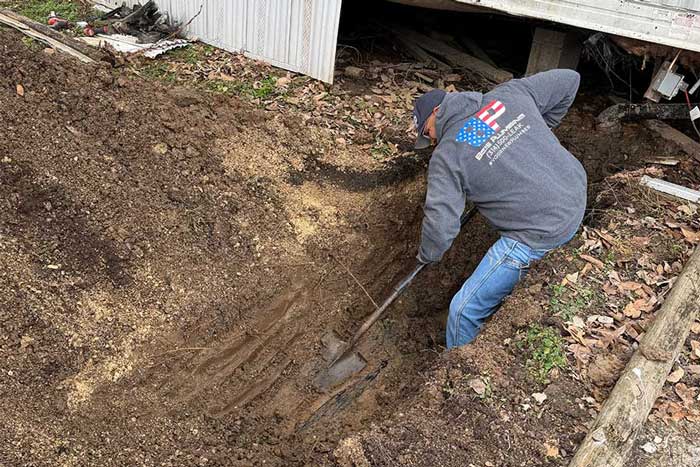
A homeowner named Susan called us one morning in early fall. She had been managing a slow basement drain for most of the summer by running hot water periodically to keep things moving, and she had noticed a faint but persistent smell near the utility room. Neither issue had been severe enough to prompt a call on its own, but when a neighbor mentioned having sewer work done after similar symptoms, she decided to stop putting it off.
The camera went in through her basement cleanout and found two separate issues within roughly 60 feet of lateral. About 30 feet from the house, a cluster of pin oak roots had entered through a joint that had separated slightly, establishing themselves across most of the pipe’s interior diameter. Flow was restricted but not fully blocked, which explained why the slow drain had been manageable for months rather than escalating to a full backup.
Further along the line, at about 55 feet, the pipe had developed a noticeable belly where the ground beneath it had settled. Solids had been accumulating in the low spot, which was contributing to the gradual reduction in flow that the root mass alone did not fully explain.
We lined the root intrusion section and spot-excavated the belly to restore proper grade, completing both in a single visit. Susan mentioned afterward that she had adjusted to the slow drain so gradually she had stopped noticing how bad it had gotten. Once the repairs were done, she said it was like having a different house.
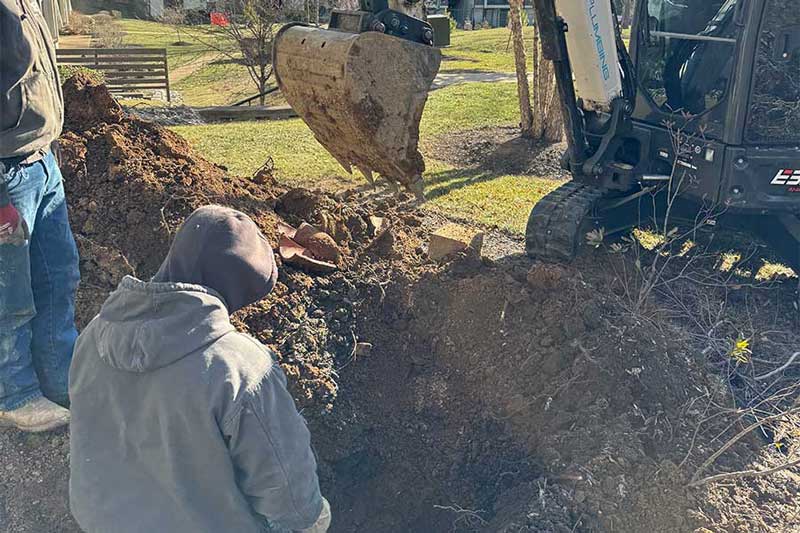
Beis Plumbing serves Olivette as part of the St. Louis area we have been working in for years. We understand the housing stock here, the soil and drainage conditions specific to this part of the county, and the way that a well-maintained surface can obscure significant infrastructure problems underneath.
We run this company on integrity. That means every recommendation we make is grounded in what the camera actually showed, not what would be easiest to sell. It means pricing is clear before the job starts and does not shift after. And it means we treat your property with the same care we would want applied to our own. Here is what every Olivette job includes:
We do the job right the first time. That is what we would want, and it is what you deserve.
Beis Plumbing serves Olivette and the surrounding St. Louis area with sewer line repair grounded in honest diagnosis and dependable work. If your home was built before 1975 and the lateral has never been inspected, a camera scope is worth scheduling before something forces the issue. Call us and we will tell you exactly what is in the ground.
Sewer line deterioration rarely happens overnight. Root intrusion builds gradually over months or years, and a belly develops incrementally as soil settles beneath the pipe. Because the symptoms, slower drains, occasional odors, periodic gurgling, arrive gradually rather than all at once, homeowners tend to adapt to each small change without registering the cumulative decline. By the time a backup forces a call, the underlying conditions have often been developing for a year or more.
Pin oaks, silver maples, and sweet gums are among the most commonly planted trees in Olivette’s residential neighborhoods, and all three produce aggressive root systems that readily exploit moisture sources underground. Silver maples in particular are known for roots that travel significant distances and enter pipe joints through very small gaps. The tree does not need to be directly above the lateral to cause problems. A root system from a tree planted at the property line or even on a neighboring lot can reach a sewer lateral running through your yard.
Yes. A belly forms when the ground beneath a section of pipe settles and the pipe sags out of grade. Root intrusion occurs when roots find and enter a joint or crack. These are independent failure mechanisms that can develop at different locations on the same lateral for entirely different reasons. When a camera inspection reveals both on the same run, it does not mean one caused the other. It means the pipe has reached an age where multiple points of failure can exist simultaneously.
Commercial corridors like Olive Boulevard generate ongoing utility work, road reconstruction, and subsurface activity over time. Each project involves some degree of ground disturbance that can transmit through the soil to adjacent residential laterals. For homes within a block or two of the corridor, the cumulative effect of that disturbance over decades can contribute to joint separation and pipe misalignment that would be less common on a quieter residential street further from the activity.
A camera inspection is a straightforward process. We access the lateral through an existing cleanout, run the camera through the line, and observe the pipe’s interior condition in real time. The inspection reveals the pipe material, the condition of joints and interior surfaces, any root intrusion or debris, and whether the pipe is running at proper grade. If we find something that needs attention, we explain exactly what it is and walk you through the repair options before recommending anything. If the pipe looks good, we tell you that too.